Seven filed US provisional patents.
A portfolio covering distributed training synchronization, edge video compression, plesiochronous multi-decoder coordination, continual fine-tuning of frozen language models, renormalization-derived numerical optimization, and probe-routing meta-optimization. TsugiCinema, Inc. is the sole assignee on all seven filings.
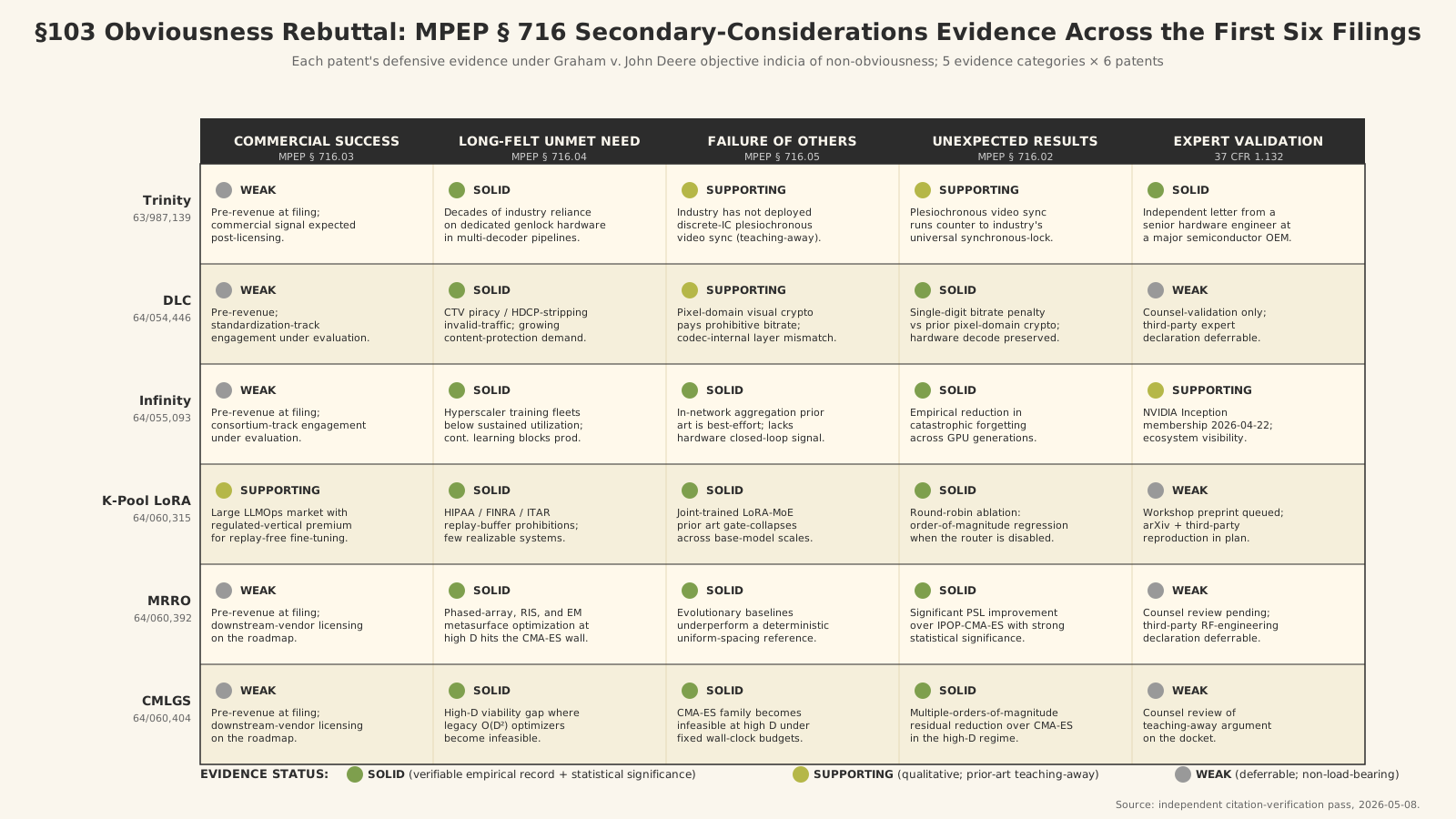
Trinity
Plesiochronous multi-decoder video synchronization with sideband-VBI phase correction.
Dual-Layer Compression (DLC)
Keyed dual-layer video compression with non-viewable layers and on-SoC dual-decoder orchestration.
Infinity
Plesiochronous gradient consensus for distributed AI training using sub-nanosecond hardware synchronization.
K-Pool LoRA
Continual fine-tuning of frozen pre-trained LLMs via a K-snapshot adapter pool with frozen-encoder routing and a sign-quantized optimizer.
MRRO
Multi-resolution renormalization optimizer for non-convex objectives with deterministic inverse-RG refinement.
CMLGS
Simplified coupled-map-lattice gradient smoothing for non-convex periodic optimization at O(D) per step.
HAMO
Probe-routing meta-optimizer for high-dimensional black-box optimization.
The filings are not independent. Three priority chains run through six of the seven.
Trinity to DLC. The sideband-VBI primitive in Trinity at video-scanline granularity is the foundational dependency for DLC. DLC is the on-SoC software lift of the same primitive at single-SoC scale. The Trinity-in-DLC bundle structure is codified via explicit cross-citations.
Trinity to Infinity to K-Pool LoRA. The plesiochronous primitive scales from video-scanline (Trinity) to gradient-tensor (Infinity). Infinity is the apparatus parent for the K-Pool LoRA software analog. The bounded retention pool, sign-quantized consensus, and quorum-hash regime ID all map directly between hardware and software.
MRRO to CMLGS. CMLGS is a multi-dimensional, computationally efficient (O(D) per step) embodiment of the MRRO operator-T family, identified in MRRO Section 4.6. Both filed same-day on 2026-05-07, twenty-two days ahead of the original target, ensuring filing-bundle coherence.
The three pair-premium stacks (Trinity + DLC, Infinity + K-Pool LoRA, MRRO + CMLGS) plus a residual cross-pair bundle effect determine the portfolio's bundle structure. Per-patent commercial detail and per-mechanism dose-response data are held back from public posting; strategic partners and investors under NDA receive the full decomposition on request via partnerships@tsugicinema.com.
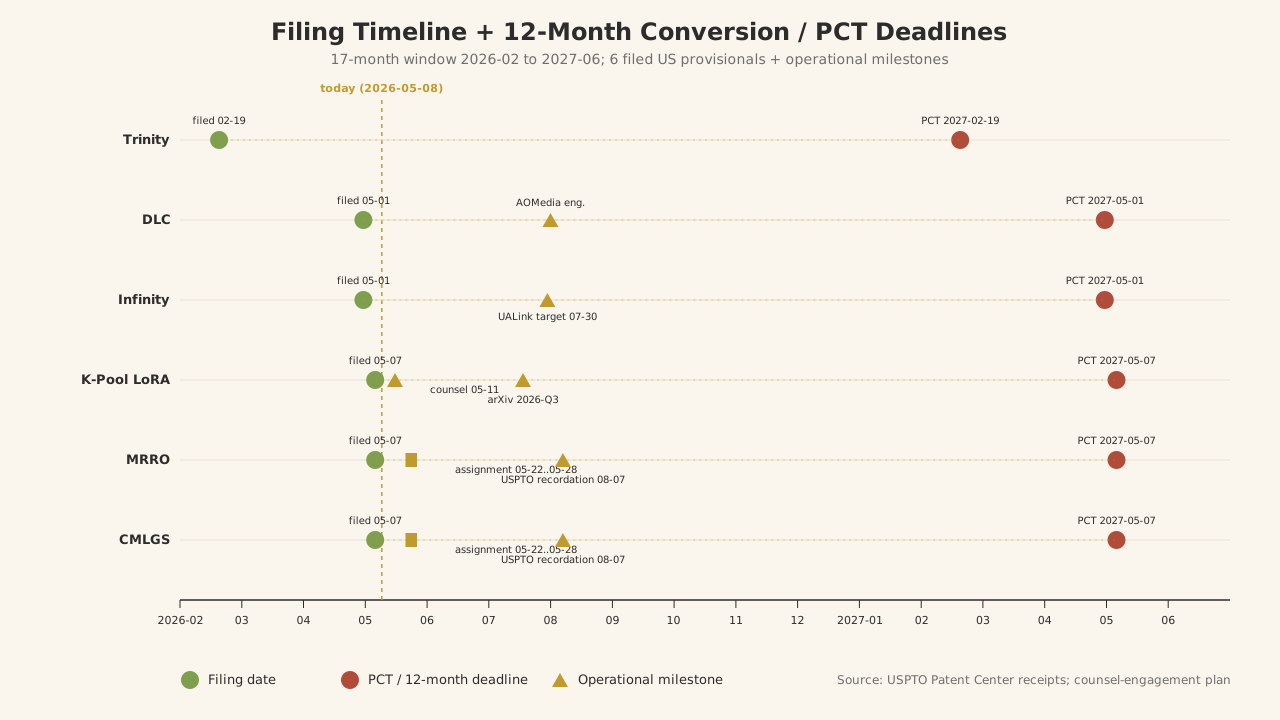
Two standards-bodies, one counsel cadence.
Target 2026-07-30
Ninety-day post-Infinity-filing engagement window. Contributor-tier membership recommended, conditional on counsel sign-off on standard-essential-patent scope. Architecturally aligned with UALink Common Specification 2.0's May 2026 update covering in-network compute and chiplet support.
Target 2026-08-01
Ninety-day post-DLC-filing engagement window. Promoter-tier membership recommended. The AV2 specification was finalized in late May 2026; the window favors secure-transport-profile addendum positioning for the AV2 12-bit professional tier.
Target 2026-Q2
Counsel engagement precedes non-provisional conversion; conversion windows run to 2027. Joint-inventor assignment instruments for MRRO and CMLGS are in progress, with USPTO recordation under 37 CFR Section 3.11 ahead of the 2026-08-07 deadline.
Infinity: a substantial reduction in catastrophic forgetting.
The Infinity provisional carries an empirical validation track that exercises the plesiochronous-gradient-consensus mechanism on a continual-learning benchmark. The headline result, reproduced across NVIDIA A100 SXM4, NVIDIA H100 SXM5, and Apple M1 Max MPS hardware within tight tolerance, is a substantial reduction in catastrophic forgetting versus the unsynchronized baseline, alongside a statistically significant lift in test-set accuracy on the same task.
Specific empirical multipliers and per-mechanism dose-response data are held back per ordinary commercial-disclosure judgment. Strategic partners under NDA receive the empirical annex on request.
Software-method portions of the portfolio (K-Pool LoRA, MRRO, CMLGS, and Infinity software-aspect claims) rely on two USPTO and Federal Circuit anchors verified at multiple authoritative sources in citation-verification passes on 2026-05-08 and re-confirmed without new citation issues on 2026-05-13.
Ex parte Desjardins (PTAB Appeal No. 2024-000567), designated precedential by USPTO Director Squires on 2025-11-04, with the MPEP Section 2106 implementation memo issued 2025-12-05. This is the load-bearing 35 USC Section 101 safe-harbor framework for the AI-method portion of the portfolio.
Recentive Analytics, Inc. v. Fox Corp., 134 F.4th 1205 (Fed. Cir. April 2025). The contrast precedent that establishes the Federal Circuit AI-eligibility doctrine. Supreme Court denied certiorari per IPWatchdog 2025-12-08.
Together these anchors are propagated through the K-Pool LoRA, MRRO, CMLGS, and Infinity software-aspect filings.
Strategic-partner inbound and patent-portfolio detail: partnerships@tsugicinema.com. Research correspondence: research@tsugilabs.ai.