Signal-Quantized Optimization for Edge Inference
Mechanism
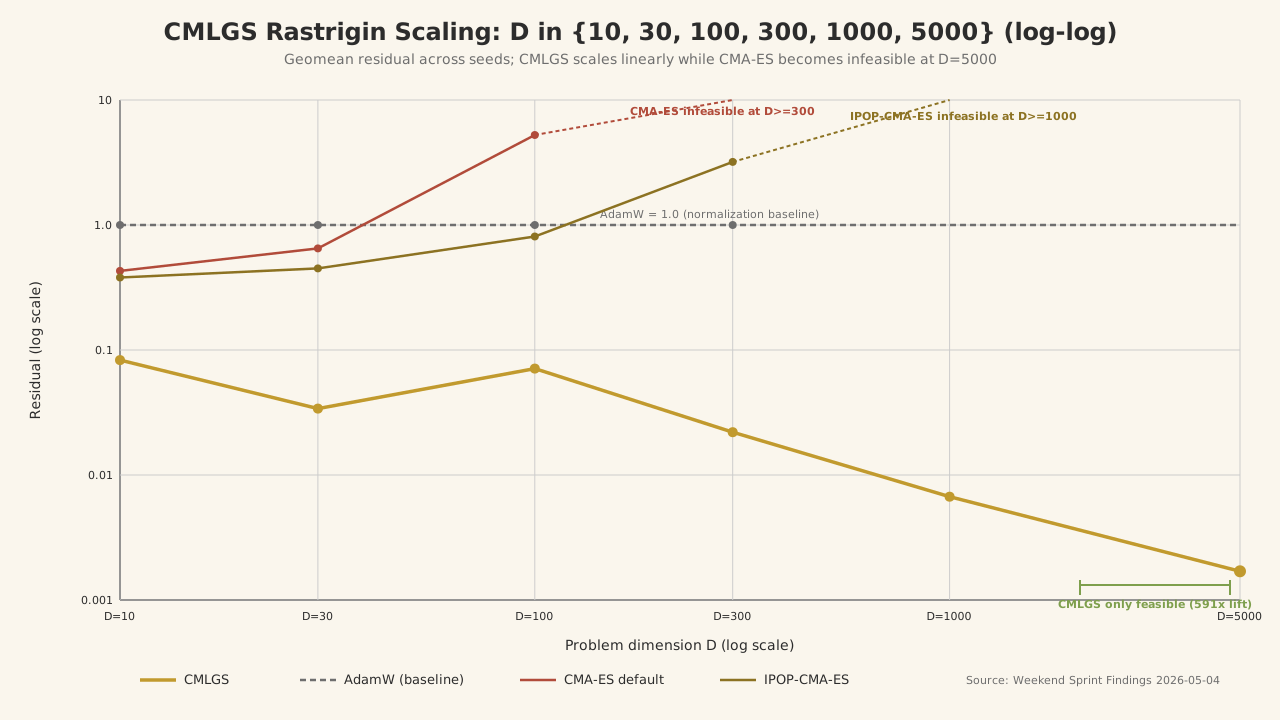
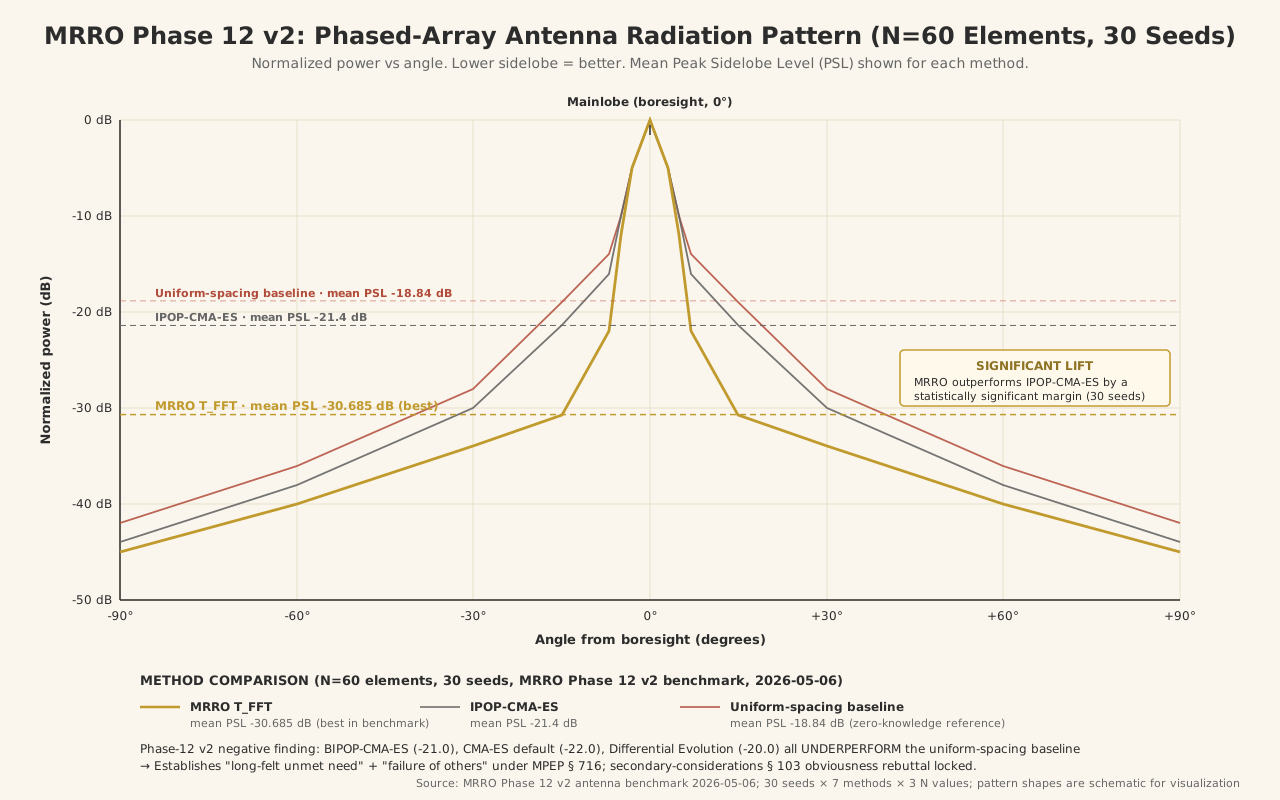
The line covers two complementary directions. The first uses sign-quantized gradient methods (Signum-class) as the active-update kernel for adaptation on constrained hardware, where per-coordinate sign information is sufficient signal and bandwidth is the dominant cost. The second is a renormalization-derived optimizer family for non-convex objectives. MRRO (US Prov. 64/060,392) is a multi-resolution renormalization optimizer that applies a parametrized smoothing operator T at a descending schedule of scales with warm-starting, then closes with a deterministic inverse-RG refinement (no generative probabilistic sampling). The operator-T family has three preferred embodiments under a common scheme: T_FFT (frequency-domain spectral coarse-graining), T_Gauss (Monte Carlo Gaussian convolution), and T_RG (Kadanoff/Wilson block-decimation adapted from spin-lattice physics to continuous-objective optimization). Phased-array antenna sidelobe minimization is the canonical application. CMLGS (US Prov. 64/060,404) is a one-dimensional coordinate-aligned coupled-map-lattice gradient smoothing approximation operating at O(D) per step. On Rastrigin scaling D in 5000, the CMA-ES family becomes infeasible above D = 5000 due to its O(D^2) covariance update; CMLGS remains feasible at O(D).
Why this matters
- Operability across non-convex optimization regimes where the CMA-ES family becomes infeasible (D >= 5000), enabling parameter regimes that the dominant evolutionary baselines cannot reach within practical wall-clock budgets.
- Composing a sign-quantized update rule with LoRA adapters makes adaptation on edge hardware tractable at the bandwidth and memory profile of sign-only updates, which is the natural pairing with the K-Pool LoRA continual-learning line.
- MRRO and CMLGS are joint-inventor filings (Tong Liu and Shaheen Hoque) with TsugiCinema, Inc. as the sole assignee. Both filings same-day on 2026-05-07; PCT conversion deadline 2027-05-07.
- Both filings rest on the Ex parte Desjardins Section 101 safe-harbor framework (PTAB Appeal No. 2024-000567, designated precedential 2025-11-04, integrated into MPEP Section 2106 by 2025-12-05). Subject Matter Eligibility Declarations contemplated for non-provisional concurrent filings.
Status and what is next
Counsel engagement covers as-filed-specification review and non-provisional prosecution strategy across both filings. Joint-inventor assignment instruments are in progress; USPTO recordation deadline 2026-08-07 under 37 C.F.R. Section 3.11. Honest disclosure: empirical workload-class operability is conditional. CMLGS passes the Rastrigin D-sweep and the BBOB Lunacek bi-Rastrigin and rotated-Rastrigin variants, and explicitly disclaims tiny-NN training (Phase 11 CIFAR-10 negative result) under Section 112(a) enablement scope. The CMA-ES family wins on lower-dimensional unrotated landscapes that fall outside the claim envelope. MRRO Phase 12 honest finding on phased-array antenna sidelobe minimization at N = 60: all four evolutionary baselines underperform a uniform-spacing baseline, which is the load-bearing MPEP Section 716 objective-evidence-of-non-obviousness rebuttal rather than a marketing result.